An Entrepreneurship Spotlight on Sydney Grims: Fearless Restaurants

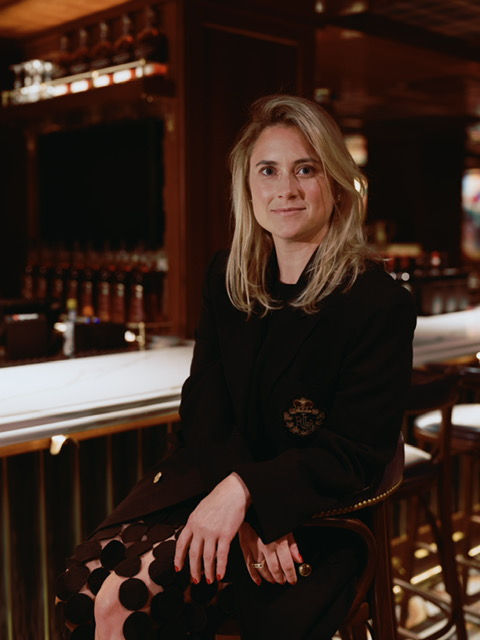
Sydney Grims is a hospitality and business-development leader and the Scarpa Center’s 2026-27 Entrepreneur in Residence. As a Partner and Director of Business Development at Fearless Restaurants, she helps guide the growth of the family-owned restaurant group’s portfolio across Greater Philadelphia and the Jersey Shore. A Cornell graduate with a background in hotel administration and real estate, Sydney brings a practical, people-centered perspective on operations, leadership, and sustainable growth. Her career has also included leadership roles with Hillstone Restaurant Group and MacAndrews & Forbes.
Q: Could you explain more about the Hillstone Group? In particular, how did your experience in the restaurant industry and seeing how a restaurant operates allow you to scale your own business?
A: So I worked for my family's business, and I worked for the Four Seasons, and that's where I learned what a standard was. I then attended Cornell, where I studied real estate finance within the hotel management school. After school, my passion was creating systems. My passion was finding efficiencies within businesses, scaling businesses, and growing something. So I went and worked for Hillstone and learned what it really meant to work within a system and how to operate a restaurant. At 23, I was running a $12 million restaurant. I was promoted through the ranks there and really saw what it meant to be a cog in the wheel and operate because, in my opinion, you really should not be providing direction to people about operations if you haven't done it yourself. Restaurants, in particular, are an industry in which you have to earn your stripes.
Q: How do you bridge the age and socioeconomic gaps present in a restaurant environment?
A: I think what really defines a good manager or leader is someone who can inspire every single person to work together. Again, I think a lot of that boils down to having been in their shoes and speaking to them in a way that is respectful, being invested in their personal lives—not in a creepy way, more like, 'How's your family? What's going on?' It's about looking at people as people instead of just as operational. Relationships are never a one-way street.
Q: What's your goal when you're evaluating other restaurants that you want to acquire? Is there a mold you're trying to fit when visualizing them in comparison with the brand at large?
A: I have a formula from a real estate perspective where I say, 'Okay, listen, I need at least 7,500 square feet.' I know what works for us. As I've built the company, I've built a back office, and we have about 30 people that we need to support in order to keep the business and the margins at a place where it's worth it from a financial perspective for everybody working there. I need to keep above a 10% margin. 10% is low; I really want to be between 12% and 15%. So, in order for that to make sense, I really need to be doing around $5 million a year in sales. In order to accomplish that, I need 7,500 square feet.
Even if they're different brands, we still look for certain qualifications from a real estate perspective to make sure that we can support them financially. At the end of the day, it's all about the real estate, and if the real estate doesn't work, it will never work. You can't force something that won't fit. Real estate, quite literally, is number one to me. It is why we have had restaurants go out of business. It's because the real estate was the problem.
Q: What would you say your overall goal is? Is it just to keep building the brand, or is there an end goal in sight?
A: Yeah, I think that my goals have really shifted as I've gone through different phases in my life. I think originally, when I joined the business, I really wanted to just expand the White Dog brand. Then I think that as I've gotten older and my priorities have changed, in order for me to expand the White Dog brand, I'd have to be on a plane a lot and travel a lot, and I hate that. I hate traveling, and I think that it provides a pretty poor quality of life for your personnel. So I think that continuing to grow in the Greater Philadelphia area is something that I'm interested in. We have a couple of great restaurants down the Jersey Shore in Long Beach Island that do very well, and I think that we will continue to grow down there a little bit.


Comments