An Entrepreneurship Spotlight on Beatrice Hilland: Happy Nomad
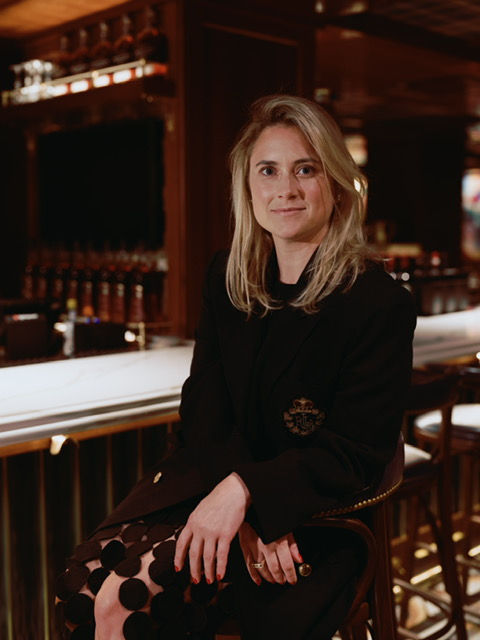
Happy Nomad, founded by Beatrice Hilland, Dayana Parra, and Nicole Garcia, is a travel-focused brand featuring Scandinavian-inspired gear for modern families. Their designs include organized gear that simplifies and elevates traveling with children. Beatrice and Katie sat down to talk more about the company and Beatrice's entrepreneurial journey.
Q: To start us off, could you tell us a little about yourself and your background?
A: I was born in Bergen, Norway. I spent my childhood there and after high school I went to Berlin, Germany to study Physical Therapy. All my family studied abroad so it was a natural step for me as well, not only to get a formal education but also to learn a new language and culture. I played soccer growing up so I wanted to stay within the sports environment as a physio. Therefore, I started working with different sports teams to learn as much as possible. Long days and lots of work eventually paid off and, after years of hustling, I got the chance to join the medical group for the Swedish Handball National Team. It was a dream job to be a part of an extremely knowledgeable medical team and experience the European Cup, World Cup, and Olympics over the years.
Q: What inspired you to start Happy Nomad?
A: During my work I bumped into a very persistent American in Sweden and long story short, we got married and had kids. Due to his soccer career, we ended up in Philadelphia. I had to put my own career on hold to make it all work with a small family. It was a tough decision, but after a while I decided to start looking into other areas that could be interesting instead. I traveled a lot back and forth to Europe with the kids at that time, and during these trips I realized how important it was to be organized to make the trips as “survivable” as possible. I looked into a lot of products but couldn't find exactly what I was looking for, so I started putting down my own ideas and that was the start of Happy Nomad.
Q: Could you walk us through your development and testing process? What did that look like in the early stages and how did you know when you had reached a version of the product that was ready to launch? Did anything change significantly from your original vision once you started developing the product?
A: My goal was to design a kid's backpack that had compartments, not pockets, so the child could quickly find what they were looking for and have it all organized. For those of you who have traveled with children, you know that this can be the difference between a complete meltdown or not. Children live by their own needs and time limits and as a parent it could be a mine field.
During the process, I brought on two co-founders, and we have tried to split the tasks amongst us based on our different skills. It’s been a fun but challenging process because, when it comes to children's products, there are so many aspects that have to be taken into consideration. It has to be interesting, functional, fun, and also be able to take a beating, so durability is important. After doing the first drawings, I managed to find a product designer who helped put together an accurate technical drawing to be sent to a factory to get a prototype made. The sourcing of factories was extremely time consuming and with a lot of setbacks, and 1 factory turned into 5. Finally, after 7 prototypes, we got one that I was pleased with. After a lot of testing with the kids, we finally had the quality and functionality we were aiming for. From beginning to end, the process took 5 years and I’m almost glad I didn’t know it would take that long when I started.
Q: Every entrepreneurial journey comes with challenges. What has been one of the biggest obstacles you faced while building Happy Nomad?
A: The biggest challenge has been to be able to develop the product on a low budget. We have no external investors; we are 3 go getters believing in this, using nothing but our own savings. Therefore, every little decision had to be really well thought out, and we had to do every part of the business by ourselves. For me personally, it was also challenging to step into a business world that was so different to the job I previously held. I’ve been part of building medical clinics, but this was completely different. I also had to learn business terminology in a language that’s not my first language, and I had to learn to network “The American Way”. Culturally, Norwegians are not that straightforward and direct, so it took me a while to be ok with approaching people without feeling I was bothering them.
Q: What has been your favorite part of your entrepreneurial journey so far?
A: My favorite part is seeing something I only had as an idea to come to life. I started jotting down my ideas at the kitchen table in 2021 and now the final product is being used by kids the way I envisioned it. It’s been a tough rodeo, but I never gave up - that’s also my favorite part of it (if I may be so blunt). I have learned so much on this entrepreneurial journey.
Q: What advice would you give to other women who are thinking about starting their own businesses?
A: I was taught from very early on that being a girl should never stop me from anything, and that is something I preach to my daughter as well. It therefore surprises me to see all these cool women with great ideas they don’t pursue further for various reasons. I’ve been to female business meetings where they brought up how intimidating it can be to be a female in a male dominated start up world. Personally, I feel we just must believe more in what we can bring to the table. No way guys have more innovative ideas than us; the difference is that they are perceived to be better at going for it and taking risks.
I’ve watched a lot of Shark Tank episodes to see other entrepreneurs. In one episode, some guys managed to get a deal selling hand-carved potatoes! They believed in their product; they believed in themselves and just went for it. I’m not sure many women would have done the same and I wish we would. No matter what the end result will be – you always learn something! We have to be better at taking calculated risks, put away “the good girl” attitude and jump into it. That’s where we have something to learn from the guys because I know good ideas we already have. :)
Q: What does the future hold for Happy Nomad?
We have now put in our first order and will start to sell our products in May/June. We have a product line ready; The main product is our now patented backpack, but we also have designed a cross-body bag, lunch bag, and a family passport holder. Moving on, we will continue to develop other products we feel are missing in the market, and it will continue to be inspired by the Scandinavian Lifestyle Style based on my background. Another important aspect of the company's future is to be able to support less fortunate families with these products. Paying it forward has always been a big part of my life from my upbringing and nothing would make me happier than seeing Happy Nomad grow globally but also making an impact by helping others on the way.


Comments