Outnumbered and Outdressed: Lessons in Law and Entrepreneurship from Milan
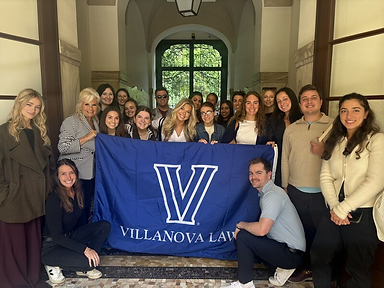
Garrett Whitton is a third-year student at Villanova University Charles Widger School of Law and a Scarpa Fellow with the John F. Scarpa Center for Entrepreneurship and Law. This past summer, Garrett participated in Villanova Law’s Legal Issues Facing International Entrepreneurs: Italy’s Fashion Industry program in Milan, Italy, led by Professor MarySheila McDonald. Through classroom lectures, industry visits, and cultural experiences, Garrett explored the intersection of entrepreneurship, international business, and fashion law. In this reflection, he shares how the experience broadened his understanding of entrepreneurship, reinforced the importance of understanding a client’s industry, and sparked an unexpected appreciation for fashion.

Before traveling to Milan, I was far from what anyone would consider a fashionista. I had little interest in fashion, knew even less about the industry, and, on most days, was perfectly content wearing gym shorts and a graphic T-shirt. Fashion law had certainly never crossed my mind as an area I might want to explore. Entrepreneurship, however, was a different story.
Entrepreneurship has become a growing fascination of mine in recent years. I enjoy tinkering with business ideas of my own and thinking about how an idea can become something real. Professor MarySheila McDonald, who has become an important mentor throughout my time at Villanova Law, helped me discover how that interest could intersect with my legal career. She has introduced me to much of the professional network I have today and, more importantly, to the legal world surrounding entrepreneurship. During my second year, I took her Law and Strategy: Entrepreneurship Attorney course, which deepened my appreciation for the role attorneys can play in helping emerging businesses navigate the challenges of building a business from the ground up.
Professor McDonald must have noticed my enthusiasm for the subject because, the next time we met, she encouraged me to consider the summer program in Milan. She explained that it would give me an opportunity to study entrepreneurship through an international lens, which immediately caught my attention. There was just one part I was not entirely sold on: fashion. When I reminded her that I knew literally nothing about it, she described the program to me as an international entrepreneurship course with a “fashion twist.” That was enough to get me thinking.
When I went home that night and gave the program a closer look, I realized that fashion did not need to be the reason I went. The course would explore subjects like intellectual property, labor and employment, compliance, and international law, all from the perspective of businesses operating in a global market. Those topics aligned closely with what had already drawn me to entrepreneurship, while offering something I could not get as easily in a classroom on campus: the chance to see how businesses and their lawyers approach these issues in a different country and legal environment. The more I thought about it, the more Milan seemed like an opportunity to broaden an interest I already had rather than study an industry I did not.
The opportunity also appealed to me on a personal level. I had obtained my Italian citizenship in 2021 but had not been back to Italy since 2017, and Milan was the one major Italian city I had yet to visit. My deep personal interest in St. Augustine, whose story is deeply connected to Milan, also gave me the chance to turn part of the trip into a little pilgrimage of my own. Adding to that was a planned class trip to the Vatican for a papal audience with Pope Leo XIV, whose connection to Villanova made the experience particularly exciting. Between the academic opportunity and these personal connections, I decided to apply and was eventually accepted.
When we arrived in Milan, I was interested to see what an international entrepreneurship course taught through the lens of fashion would look like. It did not take long for me to realize that the two subjects were far more connected than I had initially assumed. Behind every label, design, and storefront was a business dealing with many of the same questions that had drawn me to entrepreneurship in the first place. How do you build a recognizable brand? How do you protect the ideas that make it valuable? How do you expand into new markets while navigating different laws and regulations? And, perhaps most importantly, how do you turn a creative idea into a sustainable business?
Those questions followed us throughout the course. We learned from Italian attorneys, professors, and industry professionals about intellectual property and brand protection, employment law, sustainability, artificial intelligence, and the differences between starting a business in Italy and the United States. We also had the opportunity to step outside the classroom and visit the famous companies and institutions we were studying, including Armani, Gucci, Prada, and Herno.
What surprised me was how difficult it was to separate the legal issues we discussed from the fashion industry itself. I had gone to Milan thinking that I could learn more about intellectual property, employment, compliance, and international business while treating fashion as little more than the backdrop. Instead, I began to understand that advising an entrepreneur requires learning the world in which that entrepreneur operates. A trademark means more when you understand the value of a brand. Supply-chain regulation means more when you understand how and where a product is made. Even something as seemingly simple as the phrase “Made in Italy” carries legal and commercial significance. I left with a greater appreciation for the idea that understanding a client’s industry is not separate from understanding the law that governs it. That understanding also helps build rapport with a client. An entrepreneur who has devoted years to an industry wants an attorney who is genuinely interested in understanding their world, not one who views the business simply as more work. The experience showed me that learning a client’s industry is an essential part of learning how to represent that client well.
Somewhere along the way, however, something else happened. I actually started to care about fashion and the way I dressed. Spending two weeks surrounded by my classmates who knew considerably more about it than I did certainly helped. But so did visiting the Armani Silos, the Gucci museum, the Prada Foundation, and Herno. I began paying more attention to the thought behind what people wear and why they form such strong connections to certain products. By the end of the trip, my classmates had even convinced me to make a few changes to my wardrobe. The guy who arrived in Milan perfectly content in gym shorts and a T-shirt returned home thinking a little more carefully about what he put on in the morning.
Ultimately, what I gained from Milan was not simply an introduction to fashion law. The overall experience broadened the way I think about entrepreneurship and the kind of attorney I hope to become. It taught me that being an effective attorney for entrepreneurs requires curiosity beyond the law itself. It requires curiosity about an industry, the people building within it, and what makes their businesses valuable. Milan also reminded me of the value of stepping into a world I knew almost nothing about. I went because I wanted an international perspective on entrepreneurship. I came home with that perspective, a new appreciation for an industry I never expected to care about, and, much to the delight of my classmates, fewer graphic T-shirts.


Comments